


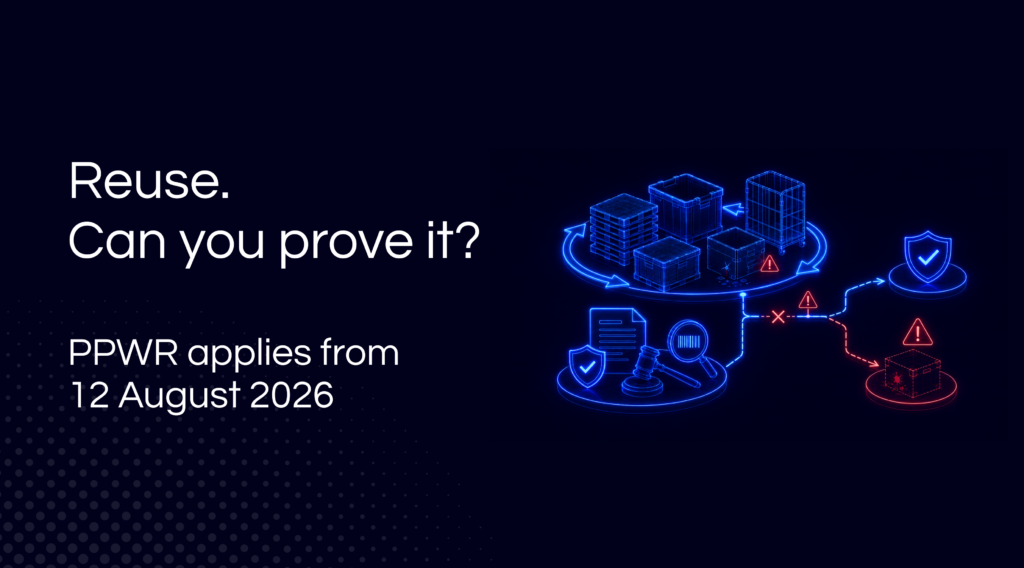
In brief: the PPWR, the new European packaging legislation, will apply from 12 August 2026. Even if you already use reusable packaging such as pallets, crates or roll containers, this does not automatically mean you are compliant. You must also be able to demonstrate that your packaging meets the technical requirements, establish who is responsible for what, and prove that your assets circulate within a reuse system. In this article, we explain what will change for each role and where to begin.
You have been working with pallets, crates and roll containers that return time and time again for years. Return flows, reuse and a functioning pool: you have it all under control. So those new European packaging rules? Surely they are mainly for companies using single-use packaging.
If only it were that simple.
From 12 August 2026, the PPWR, the new European Packaging and Packaging Waste Regulation, will apply. And it is not only concerned with whether packaging can be reused. The real question will be: can you prove it?
Because reusable does not automatically mean compliant. That distinction will become increasingly important in the years ahead.
What really matters from 12 August 2026
The PPWR aims to reduce packaging waste, prevent unnecessary packaging and encourage reuse. On paper, this is good news for anyone already working with return flows. In practice, however, there is a strict new requirement: demonstrability.
From the date the regulation becomes applicable, you must be able to demonstrate:
- that your packaging meets the technical requirements;
- who is responsible for the packaging;
- who manages the declarations and registration;
- that there is a genuinely functioning reuse system behind it;
- that you have reliable data showing where your assets are and how they move.
A strong crate alone is therefore not enough. It is about the complete story surrounding it, and whether that story stands up to scrutiny.
What exactly changes for your organisation depends on your role in the supply chain. And remember: many companies fulfil several roles at the same time.
Let’s look at where you stand.
Do you manufacture reusable packaging?
Do you produce pallets, crates, bins or roll containers? Then your responsibilities begin with the technical requirements.
As the manufacturer, you assess whether your packaging meets the applicable PPWR requirements. If it does, you document this in a Declaration of Conformity, or DoC. This is the EU declaration of conformity, and it does not stand alone. It must be supported by a technical file containing, among other things:
- a description of the packaging and its intended use;
- design drawings and technical specifications;
- the materials used and the weight of each material;
- the standards and specifications applied;
- calculations and test results;
- evidence supporting recyclability, minimisation and reusability.
The assessment rules are set out in Annex VII, while the model for the DoC can be found in Annex VIII. And you do not keep this documentation for only a year: for reusable packaging, the retention period is ten years.
Do you manufacture packaging on behalf of a customer that subsequently markets it under its own brand? Make sure it is recorded in writing who is considered the manufacturer and whose name appears on the Declaration of Conformity. Otherwise, everyone may start pointing fingers when questions arise.
Are you a pooler?
For poolers (or freight forwarders with pooling operations), more will change than simply an increase in demand. A reusable package is not merely a strong crate capable of completing many rotations. It must be supported by a well-organised system covering issuance, return, inspection and redeployment.
This means maintaining control over the entire cycle. From issuance and returns to balances by location, from cycle times and idle stock to cleaning, repair, loss, rejection and recycling.
Your customers will also begin asking for evidence. Not only of their current balance, but of how your entire system operates:
- How many packaging units are in circulation?
- How often are they used?
- What is the average cycle time?
- How many are damaged or lost?
- What happens to rejected units?
- Is the conformity documentation in order?
In principle, the manufacturer remains responsible for the technical requirements and the DoC. However, you must know what documentation is available and what you can provide to your customers. Also be aware that, in some cases, you may be classified as a producer for reporting purposes, for example when you are the first party to place empty transport packaging on the market in a particular country. This varies by country and trade flow.
In other words, pooling is no longer simply a matter of moving boxes around. It combines logistics, compliance and data management.
Do you use packaging supplied by an external pooler?
Do you rent pallets or crates from a pooler? In that case, the roles are divided. The manufacturer is responsible for the DoC, the pooler manages the system, and you use the packaging and participate in the return process.
That may sound convenient. But it does not mean you can sit back and do nothing.
At a minimum, you need to know who owns the packaging, who the manufacturer is, who manages the DoC and technical file, who submits the declarations, how receipts and returns are recorded, which data you must retain yourself, and what has been agreed in the event of loss or damage.
Request this information from your pooler or supplier now. You do not want to discover during a customer enquiry or audit that nobody knows exactly who is responsible for signing off on what.
Are you managing your own reusable packaging pool?
Many wholesalers, retailers, importers and producers own large quantities of pallets, crates, kegs or trolleys. Your core activity may be trade or production, but whether you call it this or not, you are operating your own reuse system with those assets.
That is a different situation from relying on an external pooler. You organise the returns, inspections, maintenance and redeployment yourself, or appoint the appropriate partners to do so. You must be able to demonstrate how your assets are issued, returned, registered by customer or location, inspected, cleaned, repaired, redeployed and properly processed when they are rejected.
A crate that can technically complete twenty rotations does not prove anything by itself. The question that matters is simple: does the crate actually return, and can you prove this with data?
Wearing multiple hats? It happens more often than you think
If you operate your own pool, you are always both a user and the manager of the system. However, this does not automatically make you the manufacturer or producer. If you purchase your assets from a European manufacturer, that manufacturer will usually be responsible for the conformity assessment and the DoC.
Your responsibilities increase when you manufacture the packaging yourself, import it from outside the EU, have it produced under your own brand, significantly modify the design or materials, or are the first party to place the empty packaging on the market in an EU Member State.
For each type of packaging, document who is the manufacturer, importer, producer, owner and system manager. It is a short list, but it can make a major difference when questions arise.
What about reporting obligations?
Producers must report which packaging they place on the market in each EU Member State and in what quantities. Registration in the national producer register and the related reporting obligations are both part of extended producer responsibility.
Although the PPWR establishes a common European framework, registration and reporting are organised at national level. This means that companies may need to register and report separately in every Member State in which they are considered a producer. The responsible organisation, reporting procedure and applicable deadlines may therefore differ between countries.
For transport packaging, service packaging and primary production packaging, the general principle is that the producer is the party that first makes the empty, unfilled packaging available in a Member State. Where packaging is manufactured under another company’s name or trademark, that company may instead be regarded as both the manufacturer and the producer. The exact application of these rules may depend on the circumstances and further European and national guidance.
By 12 August 2027, every Member State must have established a national producer register. Producers will be required to register and provide information on the packaging they place on that national market.
In the Netherlands, companies affiliated with Verpact are expected to be registered and reported through Verpact, provided that they supply complete and accurate packaging data. Verpact currently expects 2028 to be the first full reporting year under the new producer-register requirements, with reporting due before 1 June 2029. Companies operating in other countries should consult the relevant national authority or producer responsibility organisation, as local arrangements may differ.
The three pillars you must keep separate
With reusable packaging, three information flows can easily become confused. Let’s distinguish them clearly:
- Reporting and producer registration. This records which packaging and quantities you place on the market.
- Declaration of Conformity. This allows the manufacturer to demonstrate that the packaging is technically compliant.
- Operational asset registration. This shows where your assets are, who is responsible for them, whether they return and how often they circulate.
Three information flows, with three different purposes. Do not confuse them, but make sure all three are properly organised.
Why you need to start now
The first major reuse targets will apply from 2030. That may sound far away, but it is not. A system that genuinely works cannot be built in a single quarter.
Let’s look at the figures. From 2030, at least 40% of certain types of transport packaging must be reusable within a reuse system, with an indicative target of 70% for 2040. For transport between sites belonging to the same undertaking or linked undertakings, the target will in principle be 100% from 2030. For grouped packaging, the target begins at 10% in 2030, increasing to an indicative 25% in 2040. What exactly counts depends on the packaging type, transport route and applicable exemptions.
Pay particular attention to one phrase that appears repeatedly: these percentages only count within a reuse system, also referred to as a “system of reuse”. A collection of reusable crates that is not part of an organised system therefore does not count. It is not about what you own, but about what demonstrably circulates within such a system.
There is one more important detail: the exact calculation methodology determining which pallets or crates will count must still be established through a separate act, expected by 30 June 2027 at the latest. The percentages have been set, but the precise measurement method has not.
Do you already operate your own pool or work with a pooler? Then you are in a strong position, but only if you can demonstrate that your assets genuinely return, are redeployed, are inspected, maintained and repaired on time, do not remain idle indefinitely, and are properly processed when rejected.
The percentages are therefore only half the story. The other half is the evidence.
That is precisely why waiting until 2029 is risky. You need time to define responsibilities, request documentation, improve return processes and build reliable data. Yet many organisations still manage these processes using spreadsheets, email, a custom-built system or a limited module in their ERP platform. In our conversations with poolers, we repeatedly hear the same issues: missing transactions, incorrect references, manual work and endless discussions with customers about balances.
QR codes: hype or necessity?
From 12 February 2029, uniform labelling and digital information will become mandatory for reusable packaging. A QR code or another open, standardised data carrier must provide access to information about reusability, the reuse system, return points, instructions for use, and the data needed to calculate usage and rotations.
Does that QR code sound familiar? It might. It is similar to the Digital Product Passport you may know from another piece of European legislation, the ESPR. The digital data carrier required by the PPWR could be designed in accordance with the principles of such a Digital Product Passport, or DPP: a single QR code providing access to information about the packaging, its materials, reusability, return options and the reuse system.
Legally, the PPWR does not automatically classify this as a formal DPP. However, a DPP solution appears to be a logical way of complying with the digital information requirement. The final technical requirements will still be developed at European level.
Your checklist for tomorrow
Start by identifying your role. And remember: your organisation may fulfil several roles. Then ask the following questions for each type of packaging:
- Who is the manufacturer?
- Who prepares the DoC?
- Where is the technical file stored?
- Who qualifies as the producer under the PPWR?
- Who submits the declaration to Verpact or the relevant authority in other Member States?
- Who manages the reuse system?
- Which reuse target applies to this flow?
- How do you record issuance, returns, damage, repairs and rejection?
- Which information will need to be digitally accessible?
- Can you demonstrate that your assets are genuinely reused?
Are you unable to answer several of these questions? Then you immediately know where to begin.
Frequently asked questions about the PPWR and reusable packaging
The PPWR, or Packaging and Packaging Waste Regulation, is the European packaging legislation aimed at reducing packaging waste, preventing unnecessary packaging, and encouraging reuse and recycling. It replaces the previous packaging directive and applies directly in all EU Member States, without requiring separate national legislation.
The PPWR becomes generally applicable on 12 August 2026, 18 months after entering into force. Several obligations will follow at a later date, including the producer register, which must be established by 12 August 2027, and digital labelling for reusable packaging, which will apply from 12 February 2029.
Yes. The regulation is final and has entered into force. However, certain technical details will still be developed through separate acts, including the exact calculation methodology for the reuse targets, which is expected by 30 June 2027 at the latest.
No. Reusable does not automatically mean compliant. In addition to showing that packaging can be reused, you must demonstrate that it meets the technical requirements, establish who is responsible for it, and prove that it circulates within a reuse system.
A reuse system is an organised system covering issuance, return, inspection, cleaning, repair and redeployment. The PPWR reuse targets only count packaging that is part of such a system. Individual reusable packaging items that are not part of an organised system do not count.
The DoC, or Declaration of Conformity, concerns the technical conformity of the packaging. Reporting to Verpact concerns which packaging you place on the market and in what quantities. Reporting and registration in the producer register are connected, while the DoC is a separate requirement.
From 2030, at least 40% of certain types of transport packaging must be reusable within a reuse system, with an indicative target of 70% for 2040. For transport between sites belonging to the same undertaking or linked undertakings, the target is in principle 100%. For grouped packaging, the target is 10% in 2030, increasing to an indicative 25% in 2040.
Take control of your reusable assets
Remember that the targets only count within a system of reuse? That is exactly where TrackOnline comes in. We help poolers, retailers, trading companies, producers, suppliers and logistics service providers centrally manage their reusable packaging flows and transform a collection of assets into a demonstrably functioning reuse system.
The software brings together your physical, administrative and financial asset flows, allowing you to see at a glance what is happening across transactions, locations, balances, returns, cycle times, damage, losses and idle stock.
TrackOnline integrates with your existing ERP and financial systems and works with barcodes, RFID, BLE and IoT. This allows you to build a single, reliable data foundation for your daily asset management, collaboration with supply-chain partners and PPWR obligations.
So, honestly: do you know which role your organisation fulfils, where your documentation is stored and whether you can prove that your reusable assets genuinely circulate?