


In short: returnable packaging management is no longer a minor operational side issue. Without a grip on flows, balances and responsibilities, reusable packaging quietly grows into a serious financial burden, through loss, damage, disputes over balances and manual administration.
This blog shows where those costs arise and how to bring them down for good.
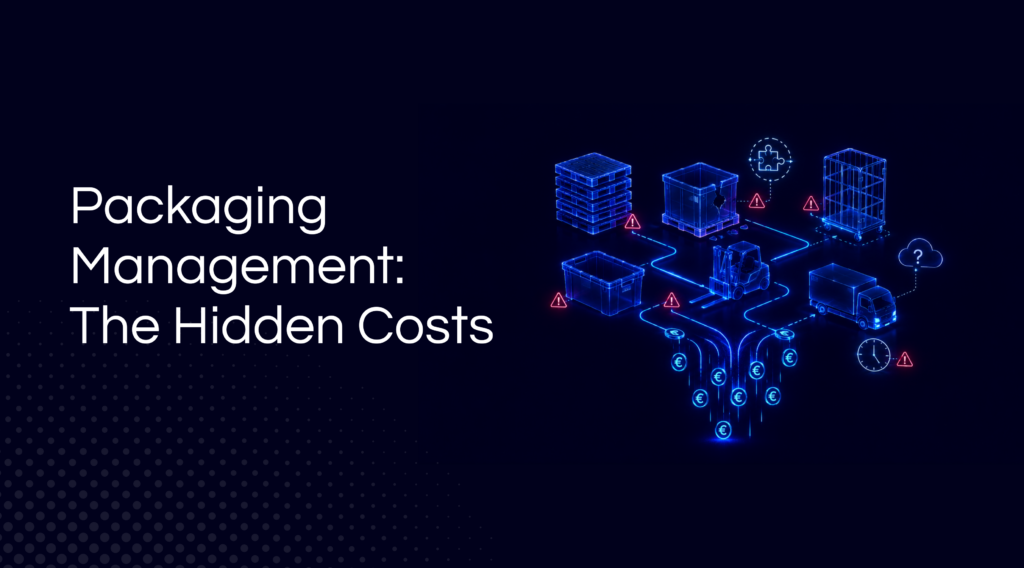
A few pallets more or less. A crate that does not come back. Sounds like noise in the margins, right?
Until you see the year end figures.
Returnable packaging management is often dismissed as an administrative side issue. In practice, that is an expensive misconception. Without a grip on your flows, balances and responsibilities, reusable packaging quietly grows into one of the larger cost items in your supply chain. And because those costs rarely come together in one place, the problem stays under the radar. Until the balance suddenly does not add up at the end of the year.
Where do the costs in packaging management disappear?
Rarely in one clear line item. Usually spread across the entire chain.
Think of buying new pallets, crates or roll containers to replace “vanished” packaging. The transport costs of your return flows. The costs of cleaning and repair. And the hours your people spend manually keeping track of who has what.
Every department sees only a slice. Logistics looks at the flows, finance at the invoices, customer service at the complaints. Nobody sees the full picture. And so the real impact only becomes visible when the balance no longer adds up at the end of the year. Exactly the moment when there is nothing left to do about it.
Why Are Losses, Damage, and Shortages So Hard to Spot?
Because packaging moves constantly. Between your own sites, customers, suppliers and carriers, day in day out.
Without a central registration system, the loss creeps in gradually. A pallet left standing at a customer. A crate that is not signed off. A roll container that simply evaporates somewhere in the chain. Each incident is small in itself. But add it up across hundreds or thousands of movements per month, and it becomes substantial. Because nobody has the full overview, those losses are discovered late. Or never.
Do the maths. Suppose you have 10,000 pallets and have to replace 5 percent of them each year due to loss, damage or rejection. At a replacement value of 15 euros each, that alone is 7,500 euros a year in replacements that better management could largely have prevented. Add the hours spent manually reconstructing balances, the write offs and extra charges from balance disputes, and the repairs you spot too late, and that avoidable cost item quickly becomes a multiple of it.
And 5 percent is on the cautious side. For untracked packaging pools, industry figures put annual loss typically between 6 and 10 percent, and in sectors like automotive it climbs to 15 to 20 percent according to Deloitte. In the United States alone, between 800 million and 1.5 billion dollars of plastic pallets and crates disappear every year. This is not a fringe phenomenon. It is a structural leak.
How Do Disputes Over Balances and Responsibility Arise?
The moment packaging changes hands, a claim arises. Who delivered what? Who has to return what? And who is liable in case of damage or shortage?
Without unambiguous, shared registration, that leads to the same discussion, over and over. Between suppliers, customers and carriers, about who is right. Those discussions cost time, put your relationship with trading partners under pressure and often end in a compromise instead of a factually correct settlement. With financial consequences for both sides.
What Does Manual Administration Really Cost?
Excel sheets, paper receipts and scattered emails. At many companies still the standard for packaging management.
That works, until the volume grows. Manual entry is error prone, time consuming and by definition delivers a delayed picture. The balance you look at today is based on data from days or weeks ago. Those hours translate directly into labour costs. And they deliver no up to date insight you can actually steer on. So you are paying for a mirror that shows the past.
Why Bad Data Eventually Becomes a Financial Cost, Too
Data that is wrong is not an operational inconvenience. It is a direct cost.
Incorrect balances lead to unjustified invoices, missed recovery of deposits and rental fees, and wrong estimates of how much new packaging you need. Decisions based on poor data cost money, even when nobody can point out exactly where. Reliable data is therefore not a nice to have. It is the foundation of financial control over your packaging flows.
How Can You Get a Better Grip on Deposits, Rental Fees, Damage Costs, and Repair Fees?
It starts with one central, up to date source of truth for all your packaging movements.
With real time registration of every transaction (who delivers, who receives, in what condition), deposits and rental fees are calculated automatically and correctly. Damage costs are assigned directly to the right party. And repair fees become part of a fixed process, instead of a loose action after the fact. That way packaging management shifts from reactive firefighting to continuous, demonstrable control over costs and responsibilities.
And the effect is significant. With good tracking, the loss rate in practice often drops from double digits to under 2 percent. On a serious fleet that quickly adds up to tens of thousands of euros in savings a year, purely on reduced loss. Let alone all the hours you no longer spend sorting things out by hand.
Want to know exactly how to get a grip on deposits, rental fees and repair fees within your own organisation? In our whitepaper Why returnable packaging management can no longer be ignored we go into this step by step.
Why This Is Also a Compliance Risk
These costs are not separate from the PPWR. From 12 August 2026 you have to be able to prove that reusable packaging demonstrably circulates within a reuse system.
And here is the twist: the same data you are now missing to explain loss and damage is exactly the data you will need to demonstrate compliance during an audit or customer query. So poor packaging management is not only a financial problem. It is also a compliance risk.
From Cost Center to Control
Packaging management has become too important to leave to loose spreadsheets and mutual trust.
If you want a grip on loss, damage, balance disputes and the associated costs, you need a system that records every flow, every transaction and every responsibility the moment it happens. Not after the fact, but live.
Your Checklist: How Much Control Do You Really Have?
Do you know how much packaging you had to replace this year, and what it cost?
- In a dispute with a customer or supplier, can you show the correct balance within a day?
- Do you know how many hours per week go into manual packaging administration?
- Are your deposits and rental fees based on current data, or on an estimate?
- Can you prove, per transaction, who is responsible in case of damage or loss?
Getting stuck on one of these questions? Then a part of your hidden costs is probably sitting right there.
Frequently Asked Questions About Reusable Packaging Management
Packaging management involves recording, tracking, and administering reusable packaging such as pallets, crates, and roll containers, including the associated inventories, deposits, and responsibilities among the parties involved.
Because losses, damages, and administrative errors gradually accumulate without a centralized overview, the actual costs usually don’t become apparent until the year-end closing.
By recording every transaction centrally and in real time, so that all parties rely on the same, verifiable data rather than separate records.
A deposit is a security deposit that is refunded when the packaging is returned; a rental fee is a periodic charge for its use, regardless of whether it is returned.